

The Four Objectives of Human Life: An Introduction to the Thought and Practice of the Path of Grace | A Commentary on the Chatuh-shloki (Four Verses) of Shri Vallabhacharya by Goswami Shyam Manohar
About the Book
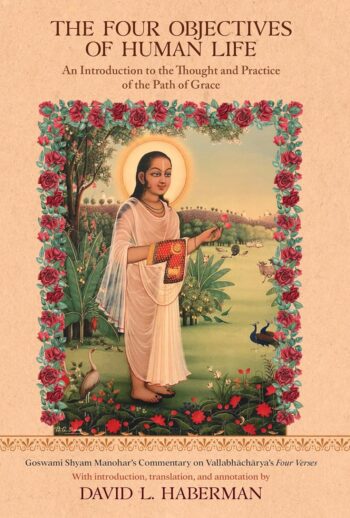
The sixteenth-century scholar saint Vallabhāchārya wrote a four-versed Sanskrit text titled the Chatuh-shlokī (“Four Verses”), which outlines the four objectives of human life from the perspective of the religious tradition he founded called the Path of Grace (Pushti Mārga). Goswami Shyam Manohar, the most preeminent and prolific scholar in the Path of Grace today, wrote a lengthy commentary in Hindi on the Chatuh-shlokī that serves well as an introduction to the thought and practice of the Path of Grace. This book makes his text available to English readers for the first time. The lengthy commentary by Shyam Manohar Goswami explains and expands on the four human objectives of sacred duty (dharma), wealth (artha), desire (kāma), and liberation (moksha). This work clearly elucidates a system of devotionalism that is resolutely nondual while allowing for a celebration of diversity and relationality. It also underscores the importance of the central practice within the Path of Grace of ghar svarūpa sevā, intimate worshipful interaction with a highly personal form of Krishna with one’s own body and wealth in the private setting of one’s home. This practice culminates in the highest bliss of the love of God.
- Author: David L. Haberman & Goswami Shyam Manohar
- Publisher: Dev Publishers
- Year: 2026
- Dimension: 21.5 x 14 x 1.5 cm
- No. of Pages: 224
- ISBN: 9789359449777
- Binding: Hardcover
- Price: ₹ 1195
About the Author
David L. Haberman is Emeritus Professor of Religious Studies at Indiana University-Bloomington (USA). His scholarly works primarily focus on the Vaishnava traditions of Braj, a sacred area in northern India associated with the stories and sacred sites of Krishna. He is the author of Acting as a Way of Salvation: A Study of Rāgānuga Bhakti Sādhana (Oxford University Press 1988, Dev Publishers, 2025), Journey Through the Twelve Forests: An Encounter with Krishna (Oxford University Press, 1994), an annotated translation of Rūpa Gosvāmin’s Bhaktirasāmritasindhu (Indira Gandhi National Centre for the Arts, 2000), River of Love in an Age of Pollution: The Yamuna River of Northern India (University of California Press, 2006), People Trees: Worship of Trees in Northern India (Oxford University Press, 2013), and Loving Stones: Making the Impossible Possible in the Worship of Mount Govardhan (Oxford University Press, 2020). The enchanting land and religious cultures of Braj continue to captivate him.
Shyam Manohar Goswami is a living direct descendent of Vallabhāchārya who belongs to the first house. He is a distinguished leader in the Pushti Mārga, recognized by many as the most knowledgeable and productive scholar in the tradition today. With a remarkable depth in both traditional training and modern academic research, as well as excellent multilingual abilities, he has published too many books to mention here, edited volumes of Vallabhāchāya’s philosophical writings, written commentaries on most of Vallabhāchārya’s works, and delivered hundreds of lectures at major universities, devotional gatherings, and live streamings on various social media platforms. He teaches courses in the Philosophy Department at the University of Mumbai, and is a recent recipient of the Indian Council of Philosophical Research (ICPR) Lifetime Achievement Award. Many recognize him as a treasure-house of Pushti Mārgīya wisdom and turn to him for authoritative interpretations of Vallabhāchārya’s treatises. He has worked closely with a number of Western academics to elucidate the tradition’s philosophy and practices. His opposition to recent commercial developments within Pushti Mārga’s devotional worship has led him to become a controversial figure in his tradition.