

Building Castles in the Air: Puspaka and the Vimanas in Sanskrit Literature
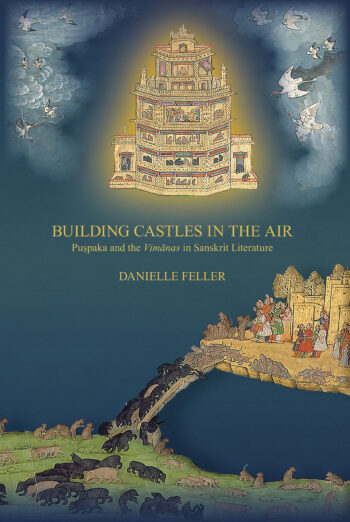
About the Book
The term vimāna is difficult to translate, as both its conception and representation
undergo a remarkably multifaceted evolution over time.
Derived from the verbal root vi-MĀ- “to measure, mete out, pass over, traverse”,
vimāna initially carries,
in the Vedic corpus, the sense of “measuring out” or
“Traversing,” as well as that of a “measure.”
In later Sanskrit literature – including the epics, the Purāṇas, fairy tales, and architectural or technical treatises – the term acquires a wide range of meanings with relevance across multiple disciplines.
These include an urban palace; a divine flying palace, foremost among which is Puṣpaka; heaven; a temple or temple spire; a small-scale structure supporting the images of deities; a man-made flying machine; and even an aircraft.
Although the original sense of “measuring” recedes after the Vedic period, its conceptual significance endures, insofar as all such forms of vimāna consistently presuppose precise measurement in their construction.
Throughout their extended historical development and across their various manifestations, vimānas bear witness to humanity’s enduring aspiration toward transcendence, functioning as vehicles that mediate contact between the divine and the human.
- Author: Danielle Feller
- Publisher: Dev Publishers
- Year: 2026
- Dimension: 23 x 15 x 1.5 cm
- No. of Pages: 190
- ISBN: 9789359446820
- Binding: Hardcover
- Price: ₹ 1595
About the Author
Danielle Feller teaches Sanskrit language and literature in the Department of Slavic and South Asian Studies at the University of Lausanne, Switzerland.
Her research focuses primarily on Indian mythology and religion, the Sanskrit epics, and kāvya literature.
The present volume, devoted to representations of Puṣpaka and vimānas in Sanskrit literature, combines her various fields of expertise and brings together the results of many years of scholarly research.